

TSH vs T3 vs T4: Understanding Thyroid Tests
Thyroid tests help identify imbalances in hormone levels that can affect your metabolism, energy, and overall health. The three main components tested are:
- TSH (Thyroid-Stimulating Hormone): Produced by the pituitary gland, it signals the thyroid to produce hormones. High or low TSH levels indicate potential thyroid issues.
- T4 (Thyroxine): A hormone produced by the thyroid, mostly inactive until converted into T3.
- T3 (Triiodothyronine): The active hormone that regulates metabolism and energy use.
Key Points:
- TSH is the first test doctors use to detect thyroid issues.
- T4 and T3 levels provide more detail when TSH results are abnormal.
- "Free" T4 and T3 (unbound to proteins) are typically measured for accurate results.
- Imbalances can signal conditions like hypothyroidism (low activity) or hyperthyroidism (high activity).
Quick Comparison Table:
| Hormone | Source | Function |
|---|---|---|
| TSH | Pituitary Gland | Regulates thyroid activity by stimulating T3 and T4 production. |
| T4 | Thyroid Gland | Main thyroid hormone; converted into active T3 in the body. |
| T3 | Thyroid/Conversion | Active form; influences metabolism, energy use, and body temperature. |
Regular testing is important for managing symptoms like fatigue, weight changes, or rapid heart rate and ensuring proper thyroid health.
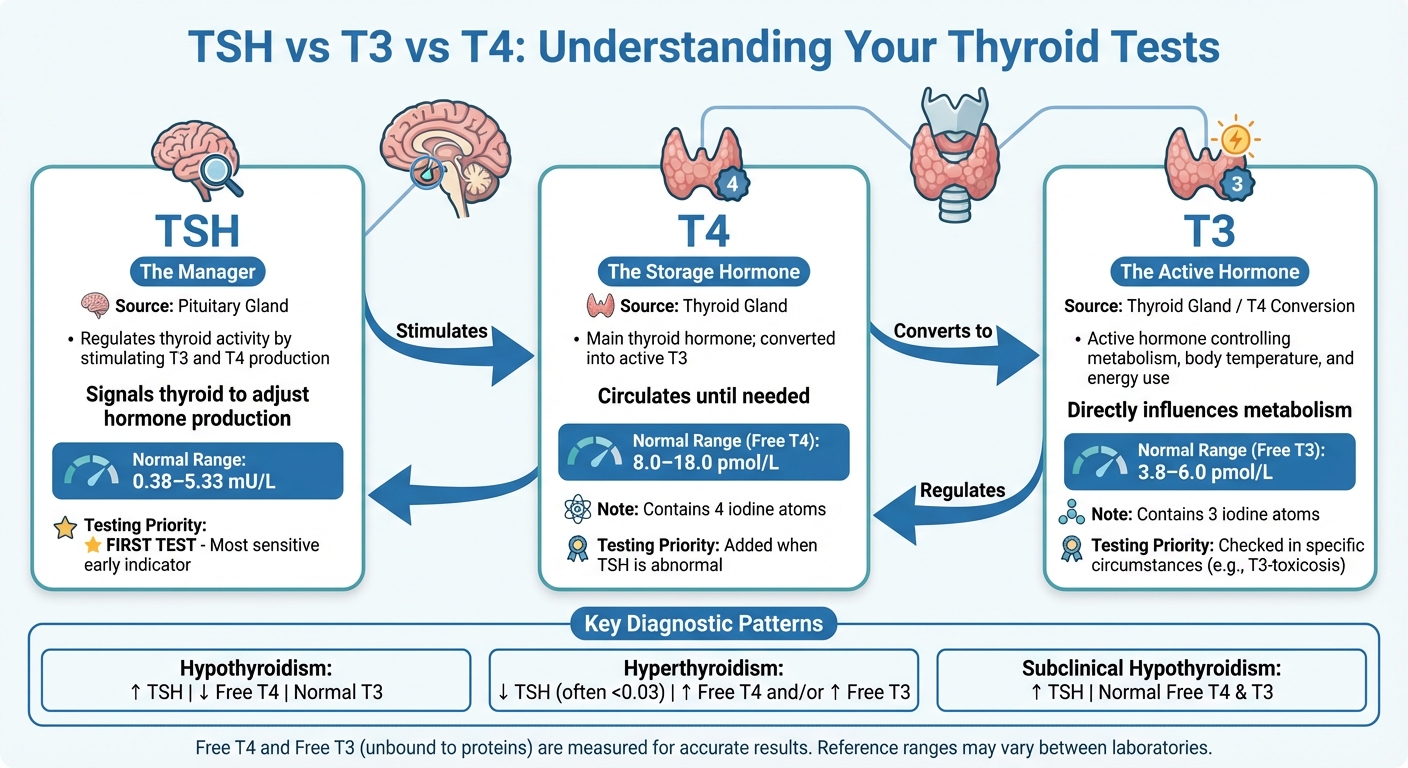
TSH T3 T4 Thyroid Hormones Comparison Chart
Thyroid function tests (TFTs) and labs explained in under 7 minutes (ish)
TSH vs T3 vs T4: The Three Main Thyroid Hormones
These three hormones work together to regulate metabolism and energy, but each plays a distinct role.
| Hormone | Source | Primary Function |
|---|---|---|
| TSH | Pituitary Gland | Stimulates the thyroid to produce T3 and T4; helps determine if the thyroid is functioning too much or too little. |
| T4 (Thyroxine) | Thyroid Gland | The main hormone produced by the thyroid; acts as a precursor that converts into active T3. |
| T3 (Triiodothyronine) | Thyroid Gland / T4 Conversion | The active hormone that controls metabolism, body temperature, and energy use. |
Let’s take a closer look at each hormone.
TSH: Thyroid-Stimulating Hormone
TSH is produced by the pituitary gland and essentially works as the thyroid’s manager, instructing it to adjust hormone production as needed. The American Thyroid Association compares this relationship to a thermostat controlling a heater: "The thyroid and the pituitary, like a heater and thermostat, turn on and off". When thyroid hormone levels are low, the pituitary releases more TSH to prompt the thyroid to produce more hormones. Conversely, when levels are adequate, TSH production slows down, ensuring balance. This feedback loop is crucial for understanding thyroid test results.
T4: Thyroxine
T4 is the primary hormone produced by the thyroid gland. It acts as a kind of storage hormone, circulating in the bloodstream until it’s needed. T4 contains four iodine atoms, and when one is removed - mainly in the liver - it transforms into T3, the active form. Since T4 is produced in larger amounts, it provides a steady supply of hormone for conversion. Most labs now measure "Free T4" (FT4) instead of total T4, as FT4 represents the unbound hormone that’s available for biological activity.
T3: Triiodothyronine
T3 is the active hormone that directly influences metabolism, body temperature, and energy use. While the thyroid produces a small amount of T3, most of it comes from the conversion of T4. Interestingly, T3 levels can remain normal even in cases of severe hypothyroidism. For instance, a person with high TSH and low FT4 might still have a normal T3 level. This is why initial thyroid testing typically focuses on TSH and T4, with T3 being checked in specific circumstances.
Normal Ranges for TSH, T3, and T4
Reference ranges represent values found in about 95% of healthy individuals, but these can differ between laboratories due to variations in equipment and testing methods. It's always important to refer to the specific reference range provided by your lab. This variability highlights why free hormone measurements are often the preferred approach for evaluating thyroid function.
In UK clinical practice, Free T4 (FT4) and Free T3 (FT3) are commonly used because they represent the biologically active forms of thyroid hormones. The rest of these hormones are bound to carrier proteins like albumin and thyroxine-binding globulin, which do not directly reflect thyroid activity.
Measurements of Total T4 (TT4) and Total T3 (TT3), which include both bound and unbound hormones, are now less commonly used. These total measurements can be misleading if protein levels are altered by factors such as pregnancy, liver conditions, or certain medications. This distinction is essential when interpreting the reference ranges outlined below.
Thyroid Hormone Reference Ranges Table
| Test | Example UK Reference Range | Units | Primary Diagnostic Use |
|---|---|---|---|
| TSH | 0.38–5.33 (or 0.4–4.5) | mU/L | Initial screen for hypo-/hyperthyroidism |
| Free T4 (FT4) | 8.0–18.0 (or 10–24) | pmol/L | Confirms thyroid function when TSH is abnormal |
| Free T3 (FT3) | 3.8–6.0 (or 4.0–7.8) | pmol/L | Helps diagnose hyperthyroidism or T3 toxicosis |
| Total T4 (TT4) | 50–160 | nmol/L | Rarely used; includes bound and unbound T4 |
| Total T3 (TT3) | 0.9–2.5 | nmol/L | Rarely used; includes bound and unbound T3 |
It's important to remember that individual factors can significantly influence these ranges. For instance, during pregnancy, TSH levels often decrease, with the normal range in the first trimester being as low as 0.05–3.70 mU/L. Additionally, age, medications (such as oral contraceptives, corticosteroids, or lithium), and underlying health conditions can all impact what is considered a normal range for you.
sbb-itb-42e7d37
How to Read Your Thyroid Test Results
Understanding thyroid test results involves looking at TSH, T4, and T3 together. TSH plays a key role in regulating thyroid hormone levels. When these hormone levels drop, the pituitary gland produces more TSH to stimulate the thyroid. Conversely, when hormone levels are high, TSH production decreases. This inverse relationship is crucial for interpreting test results correctly.
Test Patterns for Hypothyroidism and Hyperthyroidism
In primary hypothyroidism, TSH levels are elevated, while Free T4 (FT4) levels are low. On the other hand, primary hyperthyroidism typically presents with a very low or undetectable TSH (often below 0.03 mU/L) and elevated FT4 and/or FT3 levels.
Subclinical thyroid conditions reveal a slightly different pattern. Subclinical hypothyroidism involves a mildly raised TSH while FT4 and FT3 remain within the normal range. Conversely, subclinical hyperthyroidism shows a suppressed TSH but normal FT4 and FT3 levels. It's worth noting that TSH can occasionally be influenced by non-thyroidal illnesses. For this reason, an isolated abnormal TSH result should always be followed up with additional testing before deciding on treatment.
In rarer cases, central hypothyroidism is identified by both low TSH and low FT4 levels, pointing to a pituitary issue rather than a thyroid problem. Additionally, during severe illnesses, TSH and thyroid hormone levels may all appear low or normal - a pattern referred to as non-thyroidal illness or sick euthyroid syndrome. This does not necessarily indicate a thyroid disorder and should be interpreted cautiously.
These patterns help determine when T3 testing might be necessary for further evaluation.
When T3 Testing Matters
T3 testing becomes particularly important in diagnosing T3-toxicosis, a specific form of hyperthyroidism. In this condition, TSH is suppressed, T4 remains normal, but T3 levels are elevated. Without measuring T3, this diagnosis can easily be missed. T3 testing also helps assess the severity of hyperthyroidism.
"T3 testing rarely is helpful in the hypothyroid patient, since it is the last test to become abnormal." - American Thyroid Association
In hypothyroidism, T3 levels typically stay normal until the condition has progressed significantly, which limits its usefulness in early diagnosis. However, if a patient shows symptoms of hyperthyroidism despite a normal FT4, T3 testing becomes essential to rule out T3-toxicosis.
When to Test TSH, T3, or T4
TSH as the First Test
When doctors suspect thyroid issues, they typically start with a TSH test. This test is a reliable early indicator since even slight changes in thyroid hormones trigger the pituitary gland to adjust TSH production.
GPs often order TSH tests when patients report symptoms such as unexplained weight gain or loss, persistent fatigue, or other thyroid-related concerns. TSH testing is also crucial for patients taking medications that can affect thyroid function, such as Lithium or Amiodarone. For these individuals, retesting every six months is generally recommended. Additionally, if there’s been a change in thyroid hormone replacement therapy, it’s important to wait 6 to 8 weeks before retesting TSH levels to ensure hormone levels have stabilised.
When TSH results fall outside the normal range, further testing of T4 and T3 levels is usually required.
Adding T4 and T3 Tests
After an abnormal TSH result, FT4 and FT3 tests are used to pinpoint the specific thyroid issue. While TSH signals a potential problem, FT4 and FT3 provide clarity. For example, FT4 tests can help identify issues related to the pituitary gland or hypothalamus, while FT3 tests are particularly useful in diagnosing conditions like T3-toxicosis.
Some laboratories use "reflex testing", which means that if TSH levels are abnormal, FT4 and FT3 are automatically measured from the same blood sample. However, patients should be aware that Biotin supplements can interfere with test results, leading to false abnormalities. It’s recommended to stop taking Biotin at least 48 hours before testing.
Thyroid Testing at Epsom Blood Tests

Epsom Blood Tests provides thorough thyroid panels as part of their health screening services, starting at £129.00. These panels include quick, expert-reviewed results, ensuring patients receive accurate and timely information. Tests are conducted in-clinic by trained phlebotomists, and results are typically available the next day, presented in clear, detailed reports for easy interpretation.
Conclusion
Understanding thyroid health starts with recognising the role of TSH as an early signal, often changing before T3 and T4 levels show abnormalities. TSH functions as the body's warning system, highlighting potential issues that might otherwise remain unnoticed. When TSH indicates a concern, measuring Free T4 and Free T3 is critical to uncover whether the problem originates from the thyroid gland itself, hormone conversion issues, or even pituitary dysfunction.
This interconnected feedback loop – where changes in T4 and T3 influence TSH levels and vice versa – highlights the importance of comprehensive testing. Solely relying on TSH can overlook approximately 7% of thyroid imbalances. For this reason, regular monitoring is especially important for those managing thyroid conditions or taking thyroid medications.
If you’re experiencing symptoms such as fatigue or unexplained weight changes, professional testing offers clarity and accurate diagnosis. While TSH provides the first alert to potential imbalances, including Free T4 and T3 measurements ensures a fuller understanding of thyroid function – a key step in maintaining overall health.
Epsom Blood Tests provides thorough thyroid panels starting at £129.00. These tests are performed in-clinic by trained phlebotomists, with results reviewed by doctors within 24 hours. You’ll receive clear, actionable reports to better understand your thyroid health and take the next steps confidently.
FAQs
Why is TSH often the first test for identifying thyroid problems?
TSH, or thyroid-stimulating hormone, is often the go-to test for evaluating thyroid function. Why? Because it offers a reliable snapshot of how well the thyroid gland is doing its job. TSH works as a kind of manager, signalling the thyroid to produce key hormones like T3 and T4.
When TSH levels are off, it can hint at conditions like hypothyroidism (an underactive thyroid) or hyperthyroidism (an overactive thyroid). What's interesting is that these changes in TSH levels often show up before shifts in other thyroid hormones become noticeable.
This makes TSH testing a crucial first step in spotting thyroid-related issues and deciding if more detailed hormone testing is necessary.
What is the difference between Free T4 and Free T3 compared to Total T4 and Total T3?
Free T4 and Free T3 tests focus on the active forms of thyroxine (T4) and triiodothyronine (T3) that aren't bound to proteins. These unbound hormones play a key role in managing your metabolism and other essential body functions, making these tests a reliable way to assess your thyroid's activity.
On the other hand, Total T4 and Total T3 measure both the bound hormones (those attached to proteins in your blood) and the free hormones. Since bound hormones remain inactive and their levels can be influenced by protein fluctuations, Total T4 and T3 results might not always accurately represent your body's actual hormonal activity.
When is a T3 test more useful than TSH or T4 tests?
A T3 test plays an important role in diagnosing or monitoring hyperthyroidism. It measures the active thyroid hormone, which is key to many metabolic processes. This test is particularly helpful if TSH and T4 results are unclear or don’t align, offering more clarity on unusual thyroid activity.
If you’ve been dealing with symptoms like unexplained weight loss, a racing heartbeat, or excessive sweating, a T3 test might shed light on your thyroid health. To get a full picture, it’s always a good idea to consult a healthcare professional who can interpret your results and recommend the best course of action.