

progesterone testing
Progesterone testing measures hormone levels to assess ovulation, fertility, and reproductive health. It’s a key tool for diagnosing conditions like PCOS, miscarriage risk, and hormonal imbalances. For women, testing is ideally done 7 days before the next period, during the mid-luteal phase, when progesterone peaks. Men can also benefit from testing, as abnormal levels may indicate adrenal issues.
Key points:
- Confirms ovulation: Levels ≥30 nmol/L indicate ovulation.
- Diagnoses conditions: Low levels may suggest PCOS, thyroid problems, or stress; high levels could indicate ovarian cysts or adrenal disorders.
- Supports pregnancy care: Helps monitor risks like miscarriage or ectopic pregnancy.
- Testing process: Blood sample collection, lab analysis, and results (usually within 24 hours).
Epsom Blood Tests offers simple booking, quick results, and expert reviews. Accurate timing is crucial for reliable results - tracking ovulation can help determine the best day for testing.
Progesterone - Is your level too low? Too high? What does your number mean?
Why Test Your Progesterone Levels
Testing progesterone levels is a crucial step in understanding ovulation and overall hormonal health. Since ovulation issues account for around 20% of infertility cases, this test plays a key role for couples trying to conceive. Beyond fertility, it helps diagnose menstrual disorders (like amenorrhoea, irregular cycles, and abnormal bleeding), monitors early pregnancy risks, and evaluates the success of fertility treatments. This makes it an important tool for both reproductive and general hormonal health assessments.
Progesterone's Role in Reproductive Health
After ovulation, the corpus luteum produces progesterone, which prepares the uterine lining for a potential pregnancy. A progesterone level of ≥30 nmol/L, measured about seven days before a period, confirms ovulation and reflects a healthy luteal phase.
If levels fall below 10 nmol/L, it may indicate a weak luteal phase, increasing the risk of implantation failure or miscarriage. The ideal range for the luteal phase is 25–60 nmol/L. During pregnancy, progesterone supports the foetus by maintaining the uterine environment, preventing contractions, and moderating the immune response.
Identifying Hormonal Imbalances
Progesterone testing can highlight hormonal imbalances that might cause symptoms like irregular periods, hot flashes, insomnia, or perimenopausal changes. Low progesterone levels could point to conditions like PCOS, thyroid dysfunction, or chronic stress, where cortisol production takes priority. On the other hand, high levels might suggest ovarian cysts, adrenal problems, or, in rare cases, molar pregnancy. For men, elevated progesterone levels could signal adrenal conditions such as congenital adrenal hyperplasia.
When and How to Book a Progesterone Test
Best Timing for Your Test
Getting the timing right for a progesterone test is essential to ensure accurate results. The ideal time to measure progesterone is during its peak in the mid-luteal phase, which is roughly seven days before your next period. For those with a typical 28-day cycle, this would be Day 21 of your cycle (counting from the first day of your period). If your cycle is shorter or longer, adjust accordingly: for a 25-day cycle, test around Day 18; for a 35-day cycle, aim for Day 28.
Naturopathic expert Lara Briden notes that testing five to seven days after ovulation provides the most reliable results. If you track ovulation using methods like LH strips or basal body temperature monitoring, plan your test for 5–7 days after confirming ovulation. If your cycles are irregular, consider testing weekly until your period starts to capture the peak levels. Also, don’t forget to pause any biotin supplements at least 72 hours before your test, as they can interfere with the accuracy of your results.
Once you’ve pinpointed the right timing, booking your test is a breeze.
Booking Your Test with Epsom Blood Tests

After determining the best day for your test, Epsom Blood Tests offers a simple and reliable booking process. You can schedule your appointment online by selecting your preferred date and time or call 0207 183 8414 for assistance. There’s no need for a doctor’s referral – just fill out the online form with your details.
The clinic is conveniently located at 45 Stoneleigh Broadway, Epsom, KT17 2JE, and provides flexible hours from Monday to Saturday. Payment is made after your blood draw, and you can reschedule or cancel at no cost if needed. Results are usually available the next day, complete with a review by a doctor to ensure clarity and accuracy.
What Happens During Progesterone Testing
Step 1: Blood Sample Collection
When you arrive for your test, a trained phlebotomist will perform a standard venepuncture to collect your blood. To locate the best vein - usually found in the inner elbow - a tourniquet is placed around your upper arm. The process is quick, typically lasting 10–15 minutes, with the blood draw itself taking less than five minutes. Around 5–8 ml of blood is collected into a gold top gel or lithium heparin tube. Afterward, a plaster is applied to the puncture site. To make the process smoother, it’s advised to stay hydrated the day before and wear loose clothing that allows easy access to your arms. Once collected, the sample is immediately prepared for analysis.
Step 2: Laboratory Analysis
Your blood sample is sent directly to a certified laboratory for testing. Using an indirect immunoassay, the lab measures serum progesterone levels with precision. This method helps confirm whether ovulation has occurred. The sample remains stable for up to 8 hours at room temperature or up to 7 days when refrigerated at 4–8°C, ensuring accurate results.
Step 3: Getting Your Results
Results are typically ready within 24 hours. At Epsom Blood Tests, a doctor will carefully review your progesterone levels, comparing them to established reference ranges. These results provide insight into your hormonal health and confirm whether ovulation has taken place. This is a critical step, as failure to ovulate is responsible for about 20% of infertility cases.
sbb-itb-42e7d37
Understanding Your Progesterone Test Results
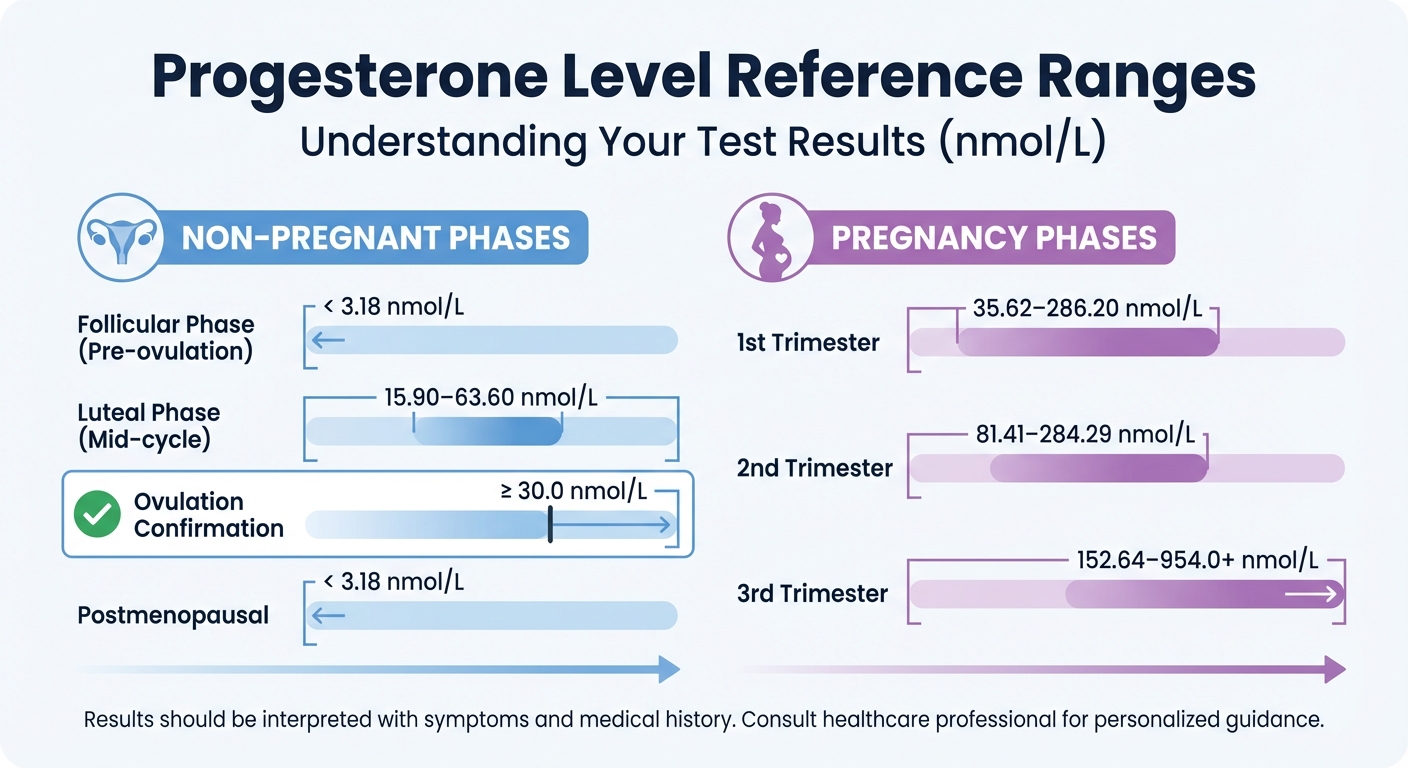
Progesterone Level Reference Ranges by Phase and Condition
Your progesterone test report provides levels in nmol/L, offering insights crucial for health decisions. This information helps connect your test results to potential treatment options.
| Phase/Condition | Normal Range (nmol/L) | Normal Range (ng/mL) |
|---|---|---|
| Follicular Phase (Pre-ovulation) | < 3.18 | < 1.0 |
| Luteal Phase (Mid-cycle) | 15.90–63.60 | 5.0–20.0 |
| Ovulation Confirmation | > 30.0 | > 9.4 |
| Pregnancy (1st Trimester) | 35.62–286.20 | 11.2–90.0 |
| Pregnancy (2nd Trimester) | 81.41–284.29 | 25.6–89.4 |
| Pregnancy (3rd Trimester) | 152.64–954.0+ | 48.0–300.0+ |
| Postmenopausal | < 3.18 | < 1.0 |
Your test results should always be interpreted in the context of your symptoms and medical history. Levels within the "normal" range don’t necessarily rule out issues, and results outside these ranges don’t automatically confirm a problem. This is why consulting with a healthcare professional is essential.
The table above provides reference values, which help explain the implications of high and low progesterone levels.
High Progesterone Levels
High progesterone levels typically indicate ovulation has occurred, placing you in the luteal phase of your cycle. A reading of ≥30 nmol/L taken seven days before your period confirms ovulation. During pregnancy, elevated levels are normal. By the third trimester, these levels can reach 152.64 to 954 nmol/L or higher to maintain the uterine lining and prevent early contractions. If you're expecting twins or triplets, levels may be even higher than in single-foetus pregnancies.
However, high progesterone outside of pregnancy could point to other conditions. Possible causes include ovarian cysts, ovarian cancer, or adrenal gland disorders like adrenal cancer or congenital adrenal hyperplasia. Exceptionally high levels during pregnancy might signal a molar pregnancy - a rare condition involving abnormal tissue growth that requires medical attention to prevent complications. Additionally, progesterone supplements, hormone replacement therapy (HRT), or certain contraceptives can affect your results. Always share details about any medications with your healthcare provider, as they can influence test accuracy.
Discuss elevated levels with your doctor to understand how they fit into your overall health picture.
Low Progesterone Levels
Low progesterone can make it harder to conceive by reducing implantation success. It may also cause irregular or heavy periods and symptoms such as mood swings, headaches, hot flashes, bloating, and fatigue. During pregnancy, insufficient progesterone increases the risk of miscarriage, ectopic pregnancy, and preterm labour.
Low levels can also disrupt oestrogen balance, leading to issues like weight gain, reduced libido, gallbladder problems, and breast tenderness. Stress plays a significant role, as high cortisol levels can suppress progesterone production. Managing stress through relaxation techniques may help maintain hormonal balance.
Low progesterone is often linked to conditions like Polycystic Ovary Syndrome (PCOS), hypothyroidism, hyperprolactinaemia, or perimenopause. Another possible cause is a luteal phase defect, where the corpus luteum doesn’t produce enough progesterone, potentially leading to early pregnancy loss. If you're trying to conceive and your levels are low, your doctor might recommend ovulation-inducing medications like Clomiphene citrate (Clomid) or Letrozole. Progesterone supplements, either vaginal or injectable, may also be prescribed to support pregnancy.
Work closely with your healthcare provider to explore treatment options and strategies for restoring hormonal balance.
Benefits of Testing at Epsom Blood Tests
Epsom Blood Tests offers more than just quick testing - it provides a seamless experience designed to deliver clarity and convenience.
Fast and Flexible Service
Traditional hospital blood tests can take up to 7 working days for results. In contrast, Epsom Blood Tests partners with efficient laboratories operating around the clock to deliver progesterone test results in under 24 hours. The service is designed to fit into your routine, offering walk-in options, same-day testing, and appointment slots during work-friendly hours. Even better, you don’t need a GP referral to access these services.
Results are shared securely through encrypted email or via a private online patient portal, ensuring both speed and confidentiality.
Expert Analysis and Clear Guidance
Your test results aren’t just numbers - they’re carefully reviewed by experienced in-house GPs or medical professionals to ensure accuracy. These experts provide clear insights into your ovulation status. If your progesterone levels are outside the standard range, you can arrange a private consultation to discuss personalised treatment options.
This tailored support ensures you fully understand your results and the steps you can take to address any concerns.
Conclusion
Progesterone testing plays a key role in understanding reproductive health, helping to diagnose fertility challenges, menstrual cycle irregularities, and hormonal imbalances. Whether you're looking into fertility concerns, monitoring ovulation, or addressing symptoms like irregular periods or mood swings, knowing your progesterone levels offers crucial insights. Early testing can uncover issues that may impact conception or overall health.
Epsom Blood Tests makes this process simple and efficient, offering quick, GP-free access with results available next day. Your results are reviewed by experienced medical professionals, who explain them in straightforward terms and provide clear next steps tailored to your needs. If your levels fall outside the expected range, private consultations are available to discuss personalised treatment options.
With walk-in availability and flexible appointment times, we prioritise convenience. Results are delivered securely through encrypted email or our private portal, ensuring both speed and confidentiality.
Take charge of your hormonal health by understanding your progesterone levels. Clear results pave the way for precise medical advice, aligning with the step-by-step care outlined earlier. Book your test today and gain valuable insights into your reproductive health and overall well-being.
FAQs
When is the ideal time to take a progesterone test for the most accurate results?
The best time to take a progesterone test is about 7 days before your next period. For someone with a standard 28-day cycle, this usually falls on day 21. If your cycle is shorter or longer, it’s recommended to test 6 to 8 days after ovulation.
This timing is crucial because it’s when progesterone levels are at their highest, offering the most accurate picture of your hormonal health. If you’re unsure about your cycle length or ovulation timing, it’s a good idea to consult a healthcare professional to pinpoint the optimal day for testing.
What does it mean if your progesterone levels are low?
Low progesterone levels can disrupt your hormonal balance, potentially causing irregular periods, challenges with conception, or even an increased risk of miscarriage. This hormone is essential for preparing the uterus for pregnancy and supporting it during the early stages.
When progesterone levels are too low, you might experience symptoms like fatigue, mood swings, or spotting between periods. By testing your progesterone levels, you can pinpoint any imbalances and explore treatment options or lifestyle changes that could help improve your overall well-being.
What are the benefits of progesterone testing for men?
Progesterone testing isn't just for women - it's a valuable tool for men to assess their hormonal health, especially the balance between progesterone and oestrogen. Progesterone plays a crucial role for men as it serves as a building block for testosterone, the hormone responsible for many male characteristics. It also helps counter the effects of oestrogen. When progesterone levels drop, men may experience symptoms like fatigue, reduced libido, weight gain, hair thinning or loss, depression, erectile dysfunction, and even muscle loss.
Beyond these symptoms, testing can reveal hormonal imbalances, such as oestrogen dominance. This condition isn't just about hormones - it can contribute to more serious health risks, including osteoporosis, arthritis, prostate problems, and even prostate cancer. Identifying such imbalances early allows men to explore solutions, whether that's hormone therapy, lifestyle adjustments, or other personalised treatments aimed at restoring balance and improving overall well-being.