

How CRP Testing Helps Detect Inflammation
CRP (C-reactive protein) testing is a simple blood test that helps detect inflammation in the body. It measures CRP, a protein produced by the liver in response to signals from the immune system. Elevated CRP levels can indicate a range of issues, from infections to chronic conditions like rheumatoid arthritis, or even cardiovascular risks.
Key points:
- Normal CRP levels: Below 0.3 mg/dL (3 mg/L) for healthy adults.
- Elevated levels: Can suggest bacterial infections, chronic diseases, or severe inflammation.
- High-sensitivity CRP (hs-CRP): Used to assess cardiovascular risk, with levels under 1.0 mg/L indicating low risk.
CRP testing is quick, requires no special preparation, and helps monitor health conditions or identify risks before symptoms appear. However, it doesn’t pinpoint the exact cause of inflammation, so further tests may be needed.
Doctor explains C-reactive protein (CRP) blood test!
sbb-itb-42e7d37
What is C-Reactive Protein (CRP)?
C-reactive protein (CRP) is a protein produced by the liver, recognised for its five-part structure and a molecular weight of about 115 kDa.
When the body experiences tissue damage or infection, immune cells release chemical messengers known as cytokines, particularly interleukin-6 (IL-6). IL-6 travels to the liver, activating genes responsible for CRP production. Other cytokines, such as interleukin-1 and tumour necrosis factor-α, also contribute to boosting CRP production.
"CRP is the principal downstream mediator of the acute‐phase response following an inflammatory event and is primarily synthesised by IL‐6‑dependent hepatic biosynthesis." – Nicola R. Sproston and Jason J. Ashworth, Manchester Metropolitan University
CRP exists in two forms: the circulating pentameric form (pCRP), which tends to have anti-inflammatory properties, and the monomeric form (mCRP), which appears during inflammation and promotes pro-inflammatory activity. Once in the bloodstream, CRP binds to damaged cells and foreign pathogens via phosphocholine, phospholipids, and histones. This activates the classical complement pathway and encourages phagocytic cells to clear out damaged or dead cells.
How CRP Indicates Inflammation
CRP is an acute phase reactant, meaning its levels rise quickly in response to inflammation. During an inflammatory event, CRP is rapidly produced and assembled in liver cells. Normally, CRP is released slowly due to its interaction with carboxylesterases, but this process speeds up significantly during inflammation, leading to rapid secretion into the bloodstream.
CRP levels in the plasma can skyrocket from around 1 µg/mL to over 500 µg/mL within 24 to 72 hours following severe tissue damage or trauma. In about 90% of cases, levels exceeding 50 mg/L are linked to acute bacterial infections. CRP has a relatively short half-life of 18–20 hours, which means its levels quickly drop as inflammation resolves.
However, CRP is a non-specific marker - it confirms the presence of inflammation but doesn’t identify its exact source or cause. The nature of the trigger determines the CRP response. For example, acute infections like sepsis or pneumonia often lead to dramatic increases above 100 mg/L, while chronic conditions such as rheumatoid arthritis result in moderate but sustained elevations, typically between 10–100 mg/L.
Why CRP Testing Matters for Health Monitoring
CRP testing is a quick and effective way to detect inflammation, often revealing its presence before symptoms like pain or fever emerge.
"It is often the first evidence of inflammation or an infection in the body, with rising concentrations frequently preceding pain, fever or other clinical indicators." – Lab Tests Online‑UK
Its rapid response to changes in inflammation makes CRP testing a valuable tool for monitoring treatment effectiveness and tracking flare-ups in chronic illnesses or optimizing performance through a sports fitness blood test. Standard CRP tests measure levels from 10 to 1,000 mg/L, while high-sensitivity CRP (hs-CRP) tests can detect lower levels, ranging from 0.5 to 10 mg/L. This makes hs-CRP tests particularly useful for assessing cardiovascular risk in individuals who appear healthy. Unlike the erythrocyte sedimentation rate (ESR), which changes more slowly over several days, CRP levels rise and fall within hours, making it a more dynamic and timely marker for health monitoring.
Understanding CRP Test Results
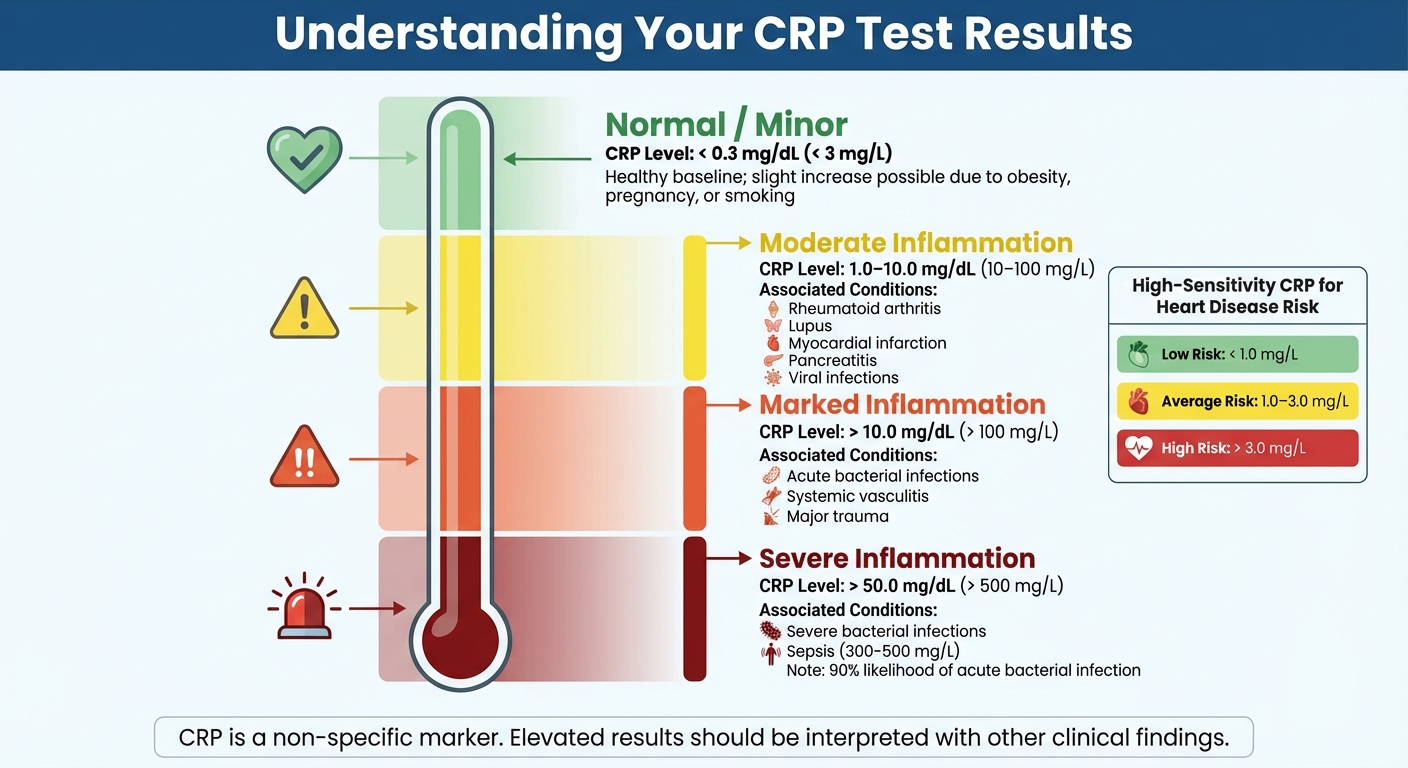
CRP Levels Chart: Normal to Severe Inflammation Ranges and Health Conditions
C-reactive protein (CRP) levels provide valuable insights into inflammation within the body. Interpreting these results helps monitor overall health and detect potential issues. For most healthy adults, CRP levels remain below 0.3 mg/dL (3 mg/L). When results fall within this range, it typically suggests no significant inflammation or tissue damage at the time of testing. In simpler terms, the liver isn’t releasing large amounts of CRP in response to inflammatory signals.
Normal CRP Levels
CRP levels under 0.3 mg/dL (or 3 mg/L) are considered normal, reflecting minimal inflammation. For cardiovascular health, high-sensitivity CRP (hs-CRP) tests are often used, where levels below 1.0 mg/L indicate a low risk of heart disease.
It’s worth noting that baseline CRP levels can vary between individuals. Women, older adults, and those of African descent may naturally have slightly higher readings. Minor increases can also result from factors like obesity, pregnancy, or smoking.
Elevated CRP Levels
When CRP levels rise above the baseline, it signals inflammation in the body. The extent of this elevation can offer clues about the underlying cause.
- Moderate elevations (1.0–10.0 mg/dL or 10–100 mg/L): These levels often point to chronic conditions such as rheumatoid arthritis, lupus, myocardial infarction, pancreatitis, or viral infections.
- Marked elevations (>10.0 mg/dL or >100 mg/L): These are typically linked to acute bacterial infections, systemic vasculitis, or major trauma.
- Very high levels (>50 mg/dL or >500 mg/L): Such readings are strongly associated with severe bacterial infections, with sepsis often pushing CRP levels beyond 300–500 mg/L.
It’s important to remember that CRP is a non-specific marker. Elevated results are usually interpreted alongside other clinical findings - like white blood cell counts, physical exams, or imaging - to pinpoint the source of inflammation.
Here’s a quick summary of CRP levels and their possible implications:
| CRP Level (mg/dL) | CRP Level (mg/L) | Interpretation | Potential Health Issues |
|---|---|---|---|
| < 0.3 | < 3 | Normal / Minor | Healthy baseline; slight increase possible due to obesity, pregnancy, or smoking |
| 1.0–10.0 | 10–100 | Moderate | Chronic conditions like rheumatoid arthritis, lupus, myocardial infarction, or viral infections |
| > 10.0 | > 100 | Marked | Acute bacterial infections, systemic vasculitis, or major trauma |
| > 50.0 | > 500 | Severe | Severe bacterial infections or sepsis (about 90% likelihood) |
Understanding these ranges and their associated conditions can help guide further medical evaluation and treatment if necessary.
Conditions Detected Through CRP Testing
CRP testing is a powerful diagnostic tool that can detect inflammation early, often before noticeable symptoms appear. Knowing the conditions it can identify highlights its importance in modern healthcare.
Acute Infections and Sepsis
CRP levels help differentiate between bacterial and viral infections. Bacterial infections often cause levels between 50–200 mg/L, while viral infections usually remain below 20 mg/L. When CRP levels exceed 100 mg/L, it may indicate sepsis, with severe cases sometimes reaching 300–500 mg/L.
"CRP is often the first evidence of inflammation or an infection in the body, with rising concentrations frequently preceding pain, fever or other clinical indicators." - Lab Tests Online-UK
Doctors frequently use CRP tests for patients showing symptoms like a rapid heart rate, fever, chills, or fast breathing to catch serious infections early. After surgeries or invasive procedures, CRP levels can signal post-operative infections even before symptoms like fever appear.
CRP testing isn’t just limited to acute infections; it’s also crucial for managing chronic inflammatory and autoimmune diseases.
Chronic Inflammatory and Autoimmune Conditions
In conditions like rheumatoid arthritis (RA) and lupus, CRP levels provide a quick snapshot of disease activity and response to treatment. When treatments are effective, CRP levels typically drop, offering clear evidence of improvement.
CRP reacts faster than older markers like the Erythrocyte Sedimentation Rate (ESR), which takes days to reflect changes. This makes CRP particularly useful for tracking sudden shifts in chronic conditions. In fact, CRP is often included in disease activity assessments to help doctors adjust treatments quickly. That said, some patients with active lupus or RA may show normal CRP levels despite ongoing inflammation, a phenomenon that remains unexplained.
Cardiovascular Risk and Inflammation
CRP testing also plays a role in assessing cardiovascular risk by detecting low-grade, chronic inflammation. Atherosclerosis, an inflammatory process affecting blood vessels, is often associated with elevated CRP levels. The high-sensitivity CRP (hs-CRP) test is specifically designed to detect these subtle levels of inflammation that standard CRP tests might miss.
According to the American Heart Association, hs-CRP levels are used to categorise cardiovascular risk:
- Low risk: Less than 1.0 mg/L
- Average risk: 1.0 to 3.0 mg/L
- High risk: Greater than 3.0 mg/L
"In atherosclerosis, the hs-CRP blood level signals how much low-grade inflammation is present in the vessel wall." - Johns Hopkins Medicine
Elevated hs-CRP levels are linked to an increased risk of heart attack, stroke, peripheral artery disease, and sudden cardiac death - even in people with normal cholesterol levels. CRP may also actively contribute to heart disease by reducing nitric oxide production, promoting LDL cholesterol oxidation, and destabilising arterial plaques, which can lead to rupture and heart attacks. For individuals with intermediate cardiovascular risk, this test helps doctors decide on preventative measures like starting statins.
Understanding how different conditions correspond to specific CRP levels underscores its role in early detection and personalised treatment planning.
How CRP Testing Works
CRP testing is simple, quick, and minimally invasive.
Blood Sample Collection
A healthcare professional collects your blood sample through a standard venipuncture process. They locate a vein - typically in the inner elbow - clean the area, and insert a needle to draw blood into a test tube. You might feel a slight pinch, but the procedure is over in just a few minutes. Once the blood is taken, pressure is applied to the site, and it's covered to prevent further bleeding.
No special preparation is needed for most CRP tests. However, if you're having a high-sensitivity CRP (hs-CRP) test alongside a lipid panel, you may need to fast for 9–12 hours beforehand. For added convenience, some services provide home testing kits, which only require a simple finger-prick sample instead of a full blood draw.
Once collected, your sample is sent off for precise CRP measurement.
Test Analysis and Results Timeline
After your sample reaches the lab, specialised equipment is used to measure CRP levels. Results are usually ready within 24 to 48 hours. Some private services offer faster turnaround times, with results available within a day. At Epsom Blood Tests, for instance, samples are analysed promptly, and next-day results are reviewed by doctors.
Standard CRP tests can detect levels ranging from 10 to 1,000 mg/L, while hs-CRP tests are designed to measure lower levels, ranging from 0.5 to 10 mg/L.
Knowing the expected timeframe for results can help you plan for any follow-up steps.
When Additional Tests Are Needed
While an elevated CRP level indicates inflammation, it doesn't reveal the exact cause. As The Forbury Clinic explains:
"CRP doesn't tell you which bug is causing trouble, only that there's an inflammatory fire burning".
If your CRP levels are high, further diagnostic tests are often necessary. These might include white blood cell counts, ESR (erythrocyte sedimentation rate) tests, imaging scans, or autoimmune panels to pinpoint the source of the inflammation. These follow-up tests are essential for identifying the root cause and guiding treatment. It's worth noting that around 1 in 20 healthy individuals may have CRP levels outside the normal range without any underlying health issue.
CRP Testing for Health Management
Regular CRP testing shifts the approach to inflammation from reactive to proactive by providing measurable data that can guide health decisions.
Monitoring Chronic Conditions
For those managing conditions like rheumatoid arthritis, inflammatory bowel disease, or lupus, CRP testing offers a reliable way to track disease activity. A drop in CRP levels often signals that treatment is working, while an increase could indicate a flare-up, prompting the need for adjustments.
CRP is a rapid marker of inflammation, responding more quickly than older methods like the erythrocyte sedimentation rate. This makes it especially useful for monitoring post-operative recovery and identifying potential complications.
Routine testing helps establish a baseline, making it easier to spot significant changes early. This allows both you and your healthcare provider to adapt treatment plans as needed. Beyond managing ongoing conditions, CRP testing also plays a crucial role in preventative care.
Using CRP Testing for Preventative Care
Even if you feel fine, CRP testing can reveal hidden risks. High-sensitivity CRP (hs-CRP) testing is particularly effective at detecting low-grade inflammation in blood vessel walls - a key factor in atherosclerosis - even when cholesterol levels are within normal ranges. This is especially helpful for individuals with an intermediate risk of cardiovascular issues.
The test categorises heart disease risk into three levels: less than 1.0 mg/L for low risk, 1.0–3.0 mg/L for average risk, and above 3.0 mg/L for high risk. These results can guide targeted actions, such as adopting an anti-inflammatory diet, incorporating regular moderate exercise, or consulting a doctor about preventative treatments.
At Epsom Blood Tests, CRP testing is often paired with a Full Blood Count as part of comprehensive health profiles. Tests are carried out in-clinic by professional phlebotomists, and results are available the next day. These are reviewed by doctors to provide you with clear, actionable insights for long-term health management.
Conclusion
CRP testing plays a key role in identifying inflammation early, monitoring chronic conditions, and assessing cardiovascular risk - even when cholesterol levels appear normal.
What makes CRP testing so valuable is its ability to detect "silent" inflammation that might otherwise go unnoticed but could lead to long-term tissue damage. As highlighted earlier, CRP levels often rise before symptoms like pain or fever develop, offering a critical opportunity for timely intervention. High-sensitivity CRP tests are particularly effective at identifying low-grade inflammation in blood vessel walls, a major contributor to heart disease.
Regular CRP testing helps you establish a health baseline, making it easier to spot significant changes early on and take specific actions. These might include adopting an anti-inflammatory diet rich in omega-3 fatty acids and leafy greens, incorporating moderate exercise, improving sleep habits, or consulting your GP about preventative options. This proactive approach ensures inflammation is addressed before it becomes a bigger issue.
Epsom Blood Tests offers CRP testing as part of comprehensive health profiles. Tests are carried out in-clinic by experienced phlebotomists, with next-day results reviewed by doctors to provide straightforward, actionable insights. With accurate results and expert analysis, Epsom Blood Tests enables you to take charge of your health and address potential concerns before they escalate.
FAQs
What can raise CRP besides an infection?
CRP levels can rise for several reasons, including tissue injury and chronic inflammatory conditions like autoimmune disorders. Lifestyle choices play a role too - factors like obesity, smoking, inactivity, and an unhealthy diet can all contribute. Additionally, certain medications, such as hormone replacement therapy, may lead to elevated CRP levels.
When should I get an hs-CRP test instead of a standard CRP?
An hs-CRP test is often suggested to evaluate the risk of heart disease or detect low-level inflammation in the body. It's more precise than a standard CRP test, as it can identify smaller fluctuations in CRP levels that are associated with cardiovascular issues. This makes it especially helpful for monitoring heart health and taking preventative steps.
How soon should a CRP test be repeated after treatment?
CRP tests are generally repeated after a minimum of 48 hours to ensure accurate results and avoid unnecessary testing. However, in certain situations, a 24-hour interval might be deemed adequate. It's essential to follow your healthcare provider's recommendations regarding the timing for retesting.